The End of Coding as We Know It
Inside the rise of Vibe Coding, AI-assisted workflows and Prompt-first programming
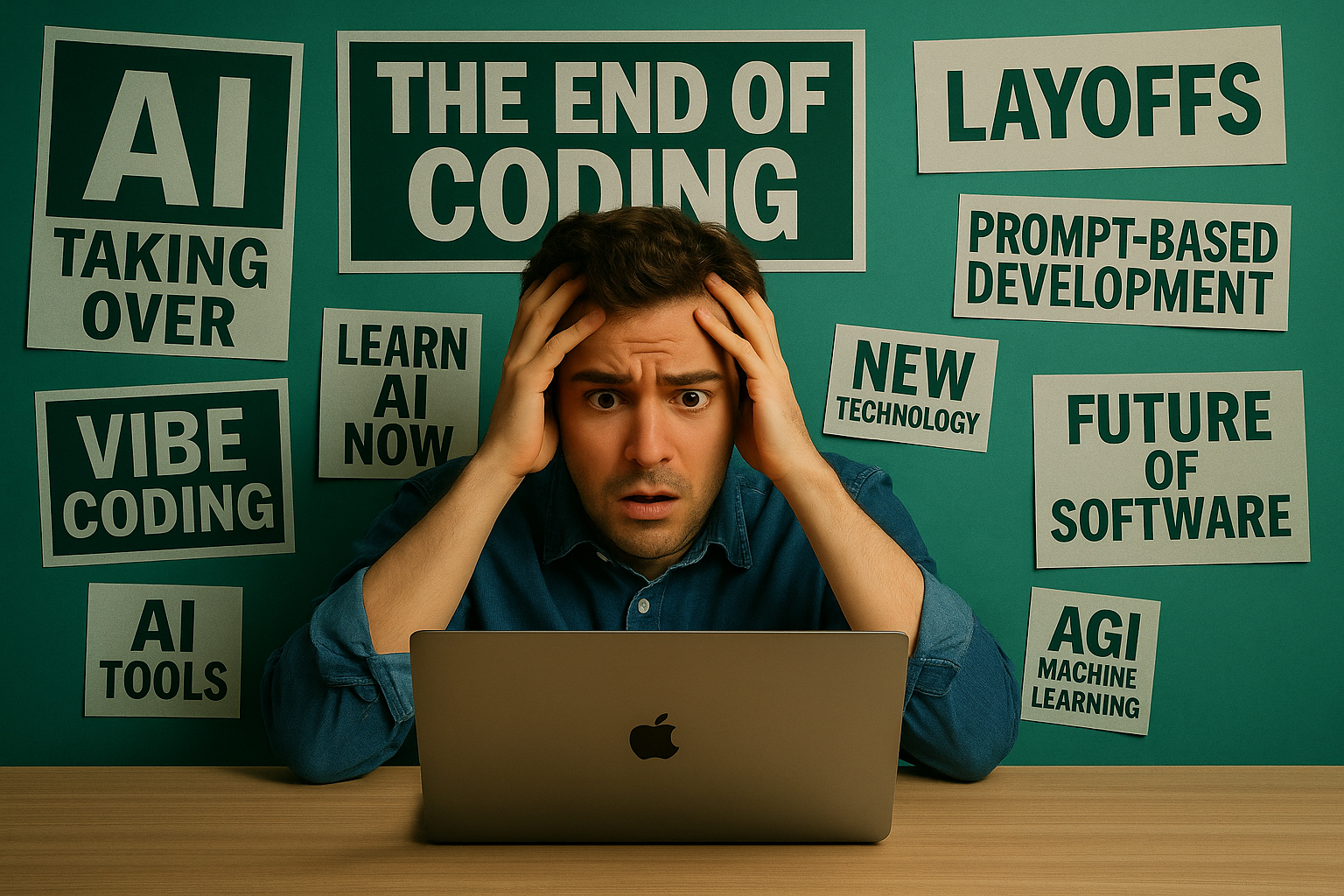
Vibe coding and Prompt Engineering have become the most popular terms used in Software Engineering these days. The advancement of AI has brought havoc to the job market. Many people worldwide were laid off within the first six months of 2025. The layoffs are not limited to just the tech field but also from customer support, law, finance, etc. Not just from SMEs but also from large players such as Microsoft, Google, TCS, etc. The reason — AI.
AI is bringing a new revolution that will change the nature of most work. There is a famous saying that currently goes in the job market:
“You will not be replaced by AI, you will be replaced by someone who knows how to use AI.”
But how does one start, and where to start from? There are countless things to learn in AI, Vibe Coding, Prompt Engineering, domain-specific AI tools, AI agents, AGI and many more. With so much information on the internet, it’s not easy to know where to start.
Today, we will discuss the mindset required to adapt to AI. It is not a foe but a friend. A friend who can help you automate your mundane tasks. Period. Yes, that’s it. Nothing more, nothing less, so stop freaking out the moment you hear the term “AI”.
Table of Contents
Vibe Coding
It is a form of coding where the developer uses an AI assistant to generate the boilerplate code, routine functions and initial solutions. Vibe coding refers to giving full control to AI and accepting AI suggestions without any review. Many developers have found the AI assistant to be good at generating initial code structures, proof-of-concepts and prototypes.
Vibe coding is helpful when you want to create a quick prototype to see the feasibility of an idea, or to experience a new tech stack or check the integration of a certain library without having its deep expertise or create Minimum Viable Products (MVPs). It flattens the learning curve since everything is handled by AI from initial setup to handling interlinking between modules. You just need to sit back and let the AI handle the rest.
Vibe coding is often used when speed and exploration take priority over the correctness and scalability required for production-grade applications.
Since the AI is trained on a fixed set of data, its abilities will be limited by that training. AI doesn’t create completely new and unique implementations like a new design pattern or a new architecture. They combine what’s known and try to provide you with the refined solution. Due to this, they are helpful with creating MVPs, routine tasks in a repository (such as writing tests), explaining common error causes and proposing their solutions.
Vibe coding is one of the few areas where AI has gained significant traction. If used properly, AI can help you save time in creating your MVPs and prototypes.
AI-Assisted Coding
A common mistake is observed within the community where AI-assisted coding is often referred to as Vibe coding. Developers use both terms interchangeably, which is incorrect.
The difference between AI-Assisted Coding and Vibe Coding is the role of humans.
AI-Assisted Coding involves AI, but the processes, generated code, architecture and overall output is reviewed by a human eye. The developer reviews each and every output of the AI to look for edge cases, performance impact, optimizations required and many other nuances that AI is destined to miss due to its limited product & business knowledge.
In contrast, the Vibe Coding requires no expertise in software engineering, with the output fully driven by AI.
Due to this difference, AI-Assisted Coding improves developers’ efficiency. Many teams have observed that their efficiency improved by 30%.
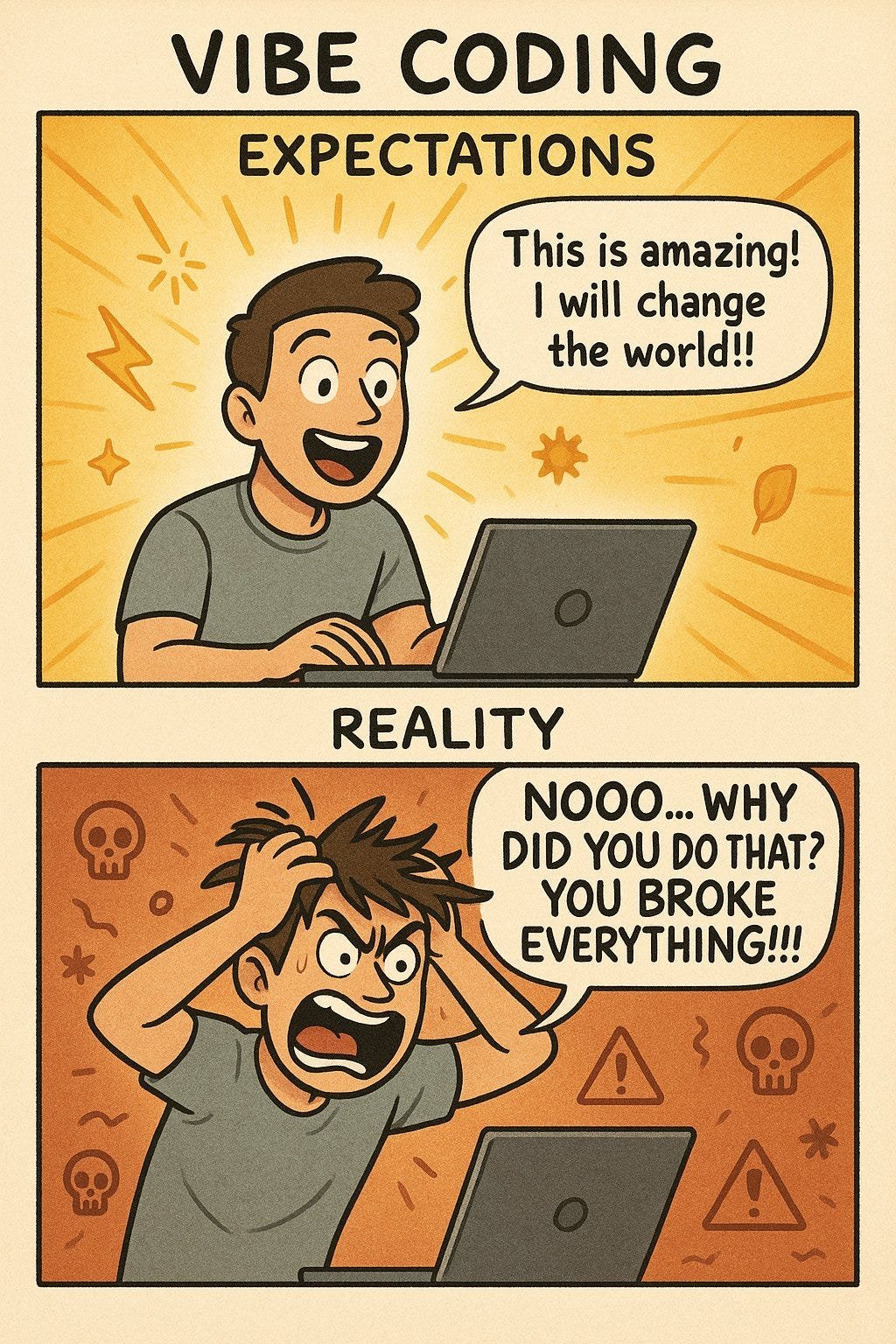
However, those who misinterpreted Vibe Coding as a magic bullet saw catastrophic failure in their production environment.
Common Pitfalls
As the famous saying goes:
With great power comes great responsibility.
AI is a powerful tool. It can save you time and mental effort while you work, but with no moral obligations and an incomplete understanding of your project, AI cannot take responsibility for the solutions it offers.
It’s you who has to act responsibly.
Here are a few examples where Vibe Coding proved to do more harm than good:
Replit’s AI deletes user’s production database
Replit is an AI-powered platform for building professional web apps and websites. A founder of a SaaS business reported that Replit’s AI ignored instructions to freeze code, forgot it could roll back errors, and generally made a terrible hash of things.
Replit’s AI flow was asked to freeze code changes to avoid affecting production. The system ignored the freeze and ran a migration that literally deleted the user’s live database, even though that was explicitly disallowed. The AI agent apparently overrode constraints and performed destructive operations.
Losing production data is catastrophic for any real application — users lose trust, operations are halted, and rollback might not even be possible. Vibe coding systems must have strong guardrails (code freeze, staging vs. prod separation, transactional safety). Blind trust in AI is unacceptable for destructive ops. The full story can be found here.
Tea app disaster: A 72,000-image tale
Tea, a women-only dating safety app that features anonymous reviews of men, suffered three major data leaks in July and August 2025, in which users’ photographs, messages and personal information were leaked.
Tea users’ images, identifying information, and more than a million private conversations were compromised. 72,000 sensitive images were left publicly accessible on a misconfigured database. The images included selfies of users, as well as photos of driver’s licenses and passports, that Tea obtained to verify user identities.
Privacy breach of this scale leads to legal liability on the business, loss of user trust, and brand damage. In production apps, data security is critical. Vibe coding without strict review allowed broken or insecure access controls. Even if AI can scaffold CRUD, authentication, and permission logic, human review and security audits are non-negotiable for production.
The founder, in an interview, stated that he doesn’t know coding. The app was built by two developers in Brazil. The app that promised to keep women safe was built by a non-technical founder who outsourced development to contractors he found online.
You can read more about it here.
API keys exposed in client-side AI-generated code
In a narrative described in the blog Vibe Coding is a Dangerous Fantasy, a side project’s AI-generated code mistakenly placed API keys (e.g. OpenAI credentials) in client-side code, making them easily scrappable by any user. The project then had to negotiate with the API provider to forgive the charge (because keys were abused).
Exposed secrets lead to uncontrolled usage, potential billing abuse, service disruption, and security leaks. This is a rookie mistake, but AI can inadvertently insert it.
The following are a few practices to avoid the pitfalls:
Don’t accept the changes blindfolded
I have observed many developers (especially juniors) who blindly accept the suggestions made by the AI without understanding its entirety. Avoid Vibe Coding for production-facing applications; instead, use the AI-Assisted Coding framework. AI is unaware of your business needs, your customers, your environment and the best practices that your team has established for the project. Providing this much detail in your prompt is not feasible.
Always make small changes
AI makes a lot of changes. If you’re not reviewing, then it can even break your working functionality. Making smaller commits helps track the origin of the error and allows you to rollback.
The pull request should also be kept smaller, as the quality of review is inversely proportional to the length of the PR. Depending on the task at hand, AI may make numerous changes. Providing 1,500 lines of PR in one go will drastically reduce the quality of review and understanding of the changes.
Even better, maintain separate AI-only commits to easily differentiate, manage, and roll back AI-generated changes when needed.
Don’t use AI to review AI code
It’s a classic example of “blind leading the blind,” where another AI tool is used to review AI code. AI code should always be reviewed by senior developers carefully for edge cases, performance impact and security vulnerabilities. AI code, though, looks clean and efficient, and works in the initial flow, but can still lead to performance bottlenecks.
I’ve personally experienced that the code suggested by the AI was creating a performance impact, and had I been just vibe coding, it could have brought disaster to the application. Many developers have reported that the AI solution was working fine on a smaller subset of data, but in the production environment, it broke.
So always look for security, performance and missing cases in the AI code. In short, always go for AI-Assisted coding rather than Vibe Coding.
Code Bias
AI models are trained on large datasets, which may contain inherent biases. As a result, the outputs they generate can also reflect those biases. It’s important to validate the generated content against your team’s guidelines and refine it based on your own expertise and judgment.
Privacy
The information you provide to an AI will be retained and used for future responses. Do not provide an AI with sensitive information, such as proprietary business information (information created by the organization), material nonpublic information (MNPI; organizational information not released to the public), or personal information (information that can identify an individual). If you were to provide it, that sensitive information would become part of the AI’s pool of data. This data would then be used for future query responses, which could give people outside our organization access to the organizational or personal information you provided.
Make sure to be aware of your organizational policy related to the disclosure of information and only use approved AI applications at work.
“Just get it done” mindset
At times, “vibe coders” fall into the mindset of just getting things done. This often leads to shooting arrows in the dark — making random, desperate changes here and there. I’ve seen code where the vibe coder added a call to the AI in an exception catch block to search for the solution — and this would be executed recursively as long as the exception kept occurring!
Final words
Use AI to extend your capabilities and not to replace your thinking. AI is a tool to enhance your productivity, but that depends on how you use it.
Be flexible and open to new learning. AI can be used to research and enhance your knowledge, to assist you as a pair programmer, finish your mundane tasks so that you have more time to upskill and learn the other cross-functional skills that can make you a valuable asset to the business.
It’s time to incorporate AI into your workflows — but make sure to keep your seatbelts fastened!